
The film 1917, was released in theaters Christmas of 2019 and the movie is a feat in it of itself. The movie is a minute shy of 2 hours and for the entire film you feel like your watching one take in real time and that’s is because you sort of are. Director Sam Mendez, producer Pippa Harris and cinematographer Rodger Deakins combined brain power and immense talent created a film that had all one takes that ran any where from 6 minutes long to 15 minutes long takes that were stitched together with hidden cuts.
Of course creating a film like this, it goes with out saying that there were going to be more than your usual obstacles. The art department, location team and camera department had to work tirelessly along with the director and actors to create multiple different sets. This included taking an empty field and digging full WWI style trenched that were the exact length of the time the scene took that was going to be shot with in them. In a behind the scenes featurette video the director Sam Mendes says “The challenges of prepping this movie re the same challenges of prepping any movies, times five. We had to measure every step of the journey… The scene has to be the exact length of the land and the land cannot be longer than the scene and the scene cannot be longer than the land. And so you have to rehearse every line of dialogue on location.” (Mendez)
A Fight Against Mother Nature:
In another article written by Vulture, the author Nate Jones, talks to producers and different department directors talk about each of their individual “hardest days on set”. For producer Harris, cinematographer Deakins, and location manager Emma Pill the weather and nature it self were there biggest threats. Because this film was shot as a oner the production team didn’t have any extra coverage to cut away too, if they couldn’t land a specific shot or if they wanted to cut something during post production because they didn’t like how it turned out. Everything in this movie had to happen otherwise you would loose the connection you had with the main characters long and argues trek.
So in order to keep continuity amongst all the long takes and because they couldn’t actually light any of the scenes since the camera would be moving on a 360 degree axis they shot the entire thing in complete cloud over and for anyone who knows anything about Great Britain it’s usually overcast there. Of course though, on day one of principal photography the sun came out to shine and wouldn’t go away. For Pippa Harris the lead producer on set, this was a nightmare. No producer and no studio wants to be behind schedule and over budget so at the end of the day when the studio called asking why they haven’t heard anything no one was happy. Harris recalled. “At about four or five in the afternoon, I got a slightly admonishing call from the studio, saying ‘You do realize you’re meant to email us when you first turn over?’ And I said, ‘Oh, well, we actually haven’t turned over yet.’ And that was of course not what the studio wants to hear on the first day of shooting.” (Harris). From this point on Harris explains this was the pacing of filming some days they would get way behind schedule and just rehearse since they couldn’t shoot and other days the rehearsing would pay off and they would get ahead again. And as a producer having to schedule for all exterior shots with no cover days was daunting. The whole production lasted for about 60 days at 5 different outdoor locations, which to Harris’s excitement met that they came in ahead of schedule and under budget.
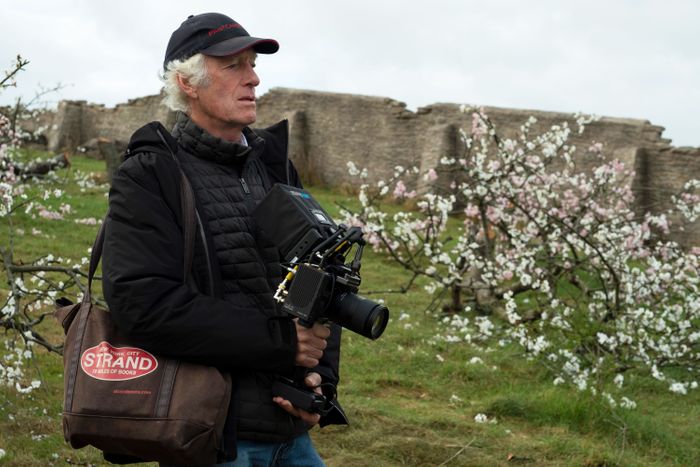
The sun was also a nightmare for Deakins as he had to be the one to call when the cloud coverage was enough to shoot and when it wasn’t and he never wanted to call it too early god forbid it went away too soon and then the entire production would have to go back to one. The issue with each take was that once it got started everything was in motion because usually no one was calling cut until the whole 8 to 10 minute scene was finished. “Deakins recalled. “I spent a lot of time watching the sky, and looking at weather apps on my phone, seeing when clouds might come in.” But even that was an imperfect method. “Sometimes you would think the radar would show a cloud system and some light rain coming towards you, but it would dissolve by the time it came to us. It was really frustrating.” (Jones)
On the complete other side of the spectrum, location coordinator, Emma Pill had to find replicas of WWI battle scenes with out actually being able to use the real sites because the were protected historical landmarks. So the main location that had the trenches dug into it was “Salisbury Plains” which is right next to Stonehenge. After digging and shooting in the trenches Emma had to ensure that the field would be put back to their previous state and she had to make sure that the protected wild life and protected archaeological items that lived on and where buried at the plains wasn’t disturbed. This met that Pill was working day and night with Ornithologists and had to get herself a proper license to exhume bodies. “Pill had the fields geo-scanned to ensure production did not disturb any remnants of Bronze Age culture. That included any three-thousand-year-old corpses that may have been lying around. “I had to get a license to exhume bodies,” she recalled. “Obviously if they were modern bodies, you’re calling the police. But ancient bodies, you have to have a license to have permission to exhume them from the ground.” (Heckman)
Thankfully they never did come across any bodies but they did run into troubles with the protected birds on set. After they built the entire worn down barn set and finished wrapping production on it they were set to strike it. But before tearing it down set designers found nests of the birds inside the barn and Ornithologists told them that they couldn’t tear it down and to wait for the birds to naturally just leave. “We couldn’t strike the barn because some swallows and wagtails had decided it was a perfect environment to nest,” Pill recalled. It is against the law to disturb a birds’ nest, and so there was nothing to do but bring in an ornithologist, and watch and wait until each loving couple eventually flew the coop — which they finally did, weeks later.” (Pill) It did put them behind schedule, but the team couldn’t blame the birds since it they were the ones who built the birds the perfect home in an already perfect environment.
This film had plenty of set back and plenty of obstacles, but for the entire production team it was a complete success. They were able to create an incredibly beautiful and technically advanced film that did great in theaters and even better during awards season. The use of the single take and the attention to detail that the camera department, set designers and stunt coordinators had created a story that was so enthralling and nail biting and at the same time completely hidden. For most of the film you can’t tell why you feel so immersed in the story, but then you realize it’s because you’re there with the character the whole time, and you never miss a beat or cut away. Just like the character you never have a chance to take a break and just breathe.

