
The Effects of At Home Learning
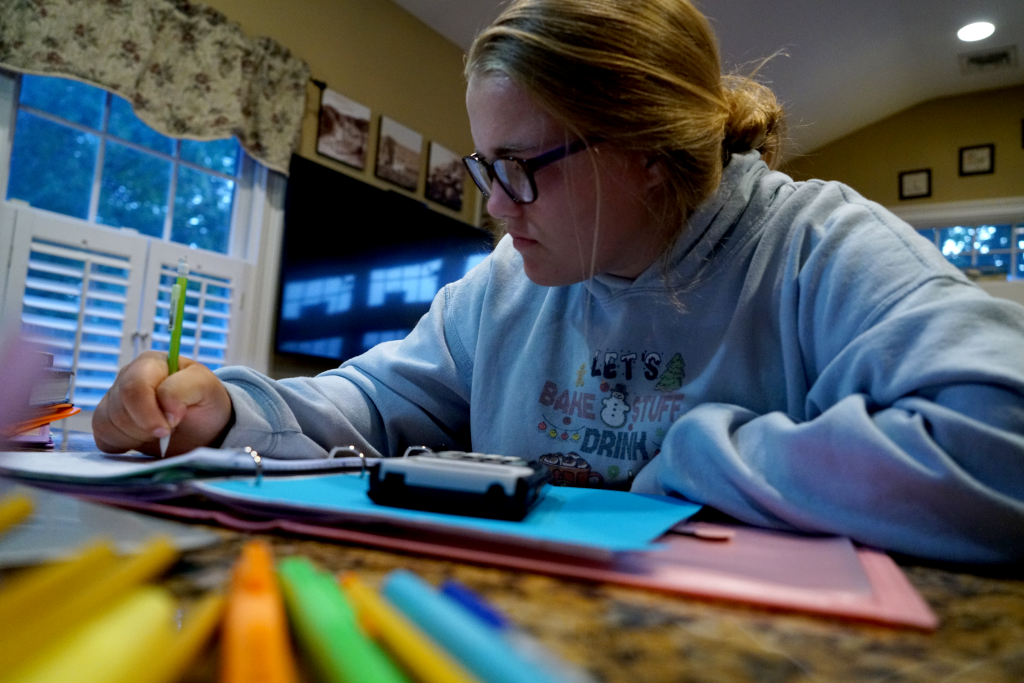
As a journalism major myself in undergrad, I always hated a story that just had text. I’m a big visual learner so being able to read a graphic, flip through photos or watch a video is always more impactful to me then just reading. Throughout my time in journalism classes and just as someone who skims through a lot of news articles it’s come to my attention that the stories that stick with me longer are the ones that weave their visuals into the story and make it a necessary part of the piece and not an after thought that you could skip over if you wanted to. In an article written by Garcia Media, the author, Mario Garcia notes the advancement in news outlets when planning their visuals before researching and writing a story. “We are talking visual journalism here, which continues to involve the use of photos, videos, infographics, but not as an appendix to the story, but woven into the texture of it.” (Garcia).
Currently in the world the COVID-19 pandemic is still very much an issue so students who are currently going back to school aren’t actually going back into the building quite yet. They’re stuck at home trying to navigate education, extracurriculars and a social life all while never leaving the couch. And from an outside perspective that might seem easier then waking up early everyday and go into school, but if you look at any average student you’ll seen plain as day on their faces, they’re tired and struggling.
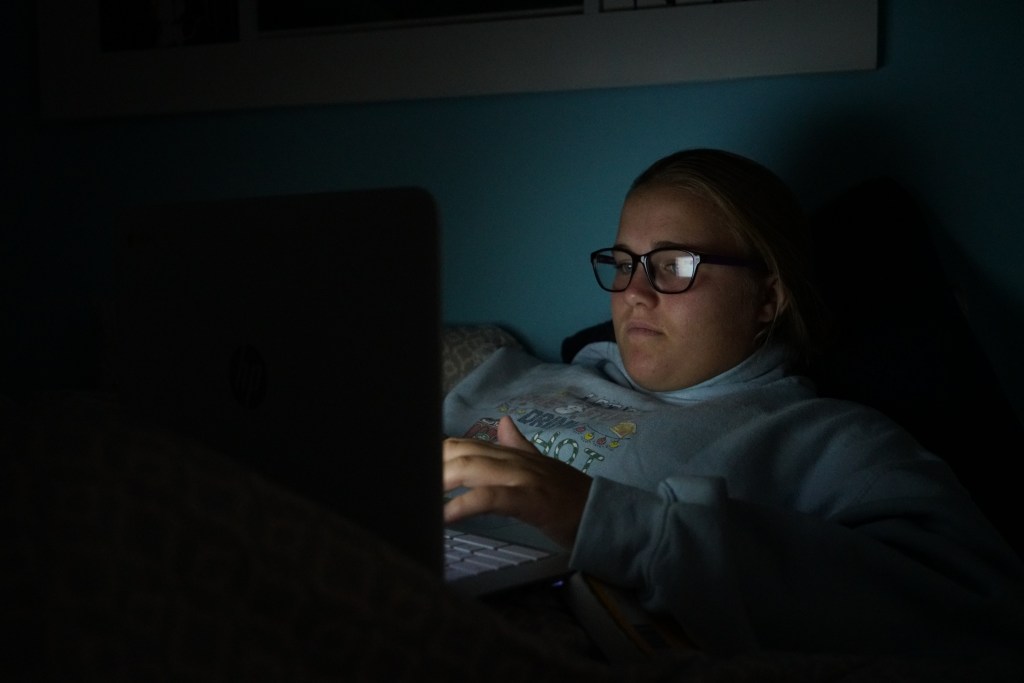
Kelly wakes up in the morning and before even getting out of in the morning. She logs on and just sits. There is no routine anymore. No morning outfit picking. She opens her computer and starts her 6 hours straight of staring at her computer.
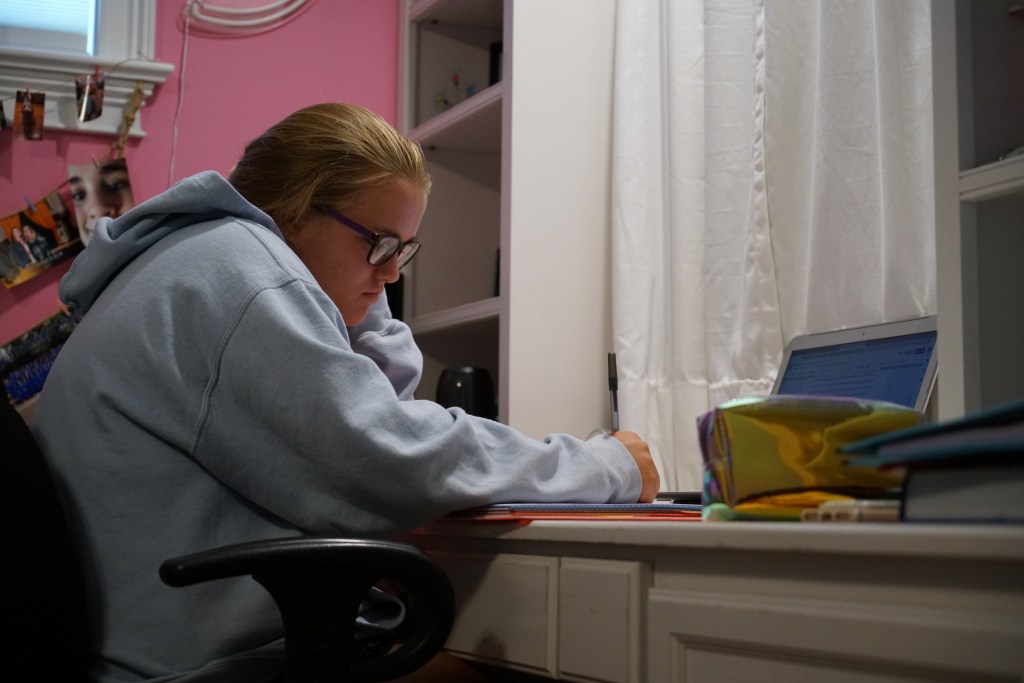
Throughout the day Kelly moves positions between classes so she can still feel like there is some change between classes and that it’s not the same thing over and over again. Most days she starts in her bedroom and slowly migrates through out the house. Kelly is a lucky kid though. She does have her own work area. But many kids through out this process don’t have their own place to work and have been struggling with distractions due to this.

Even while in class, distractions and boredom take over for students. Having easy access to snacks at any time and having the ability to step away from a lesson because there’s no one to tell to you you can’t is hard for a kid. With no structure students tend to stop caring.
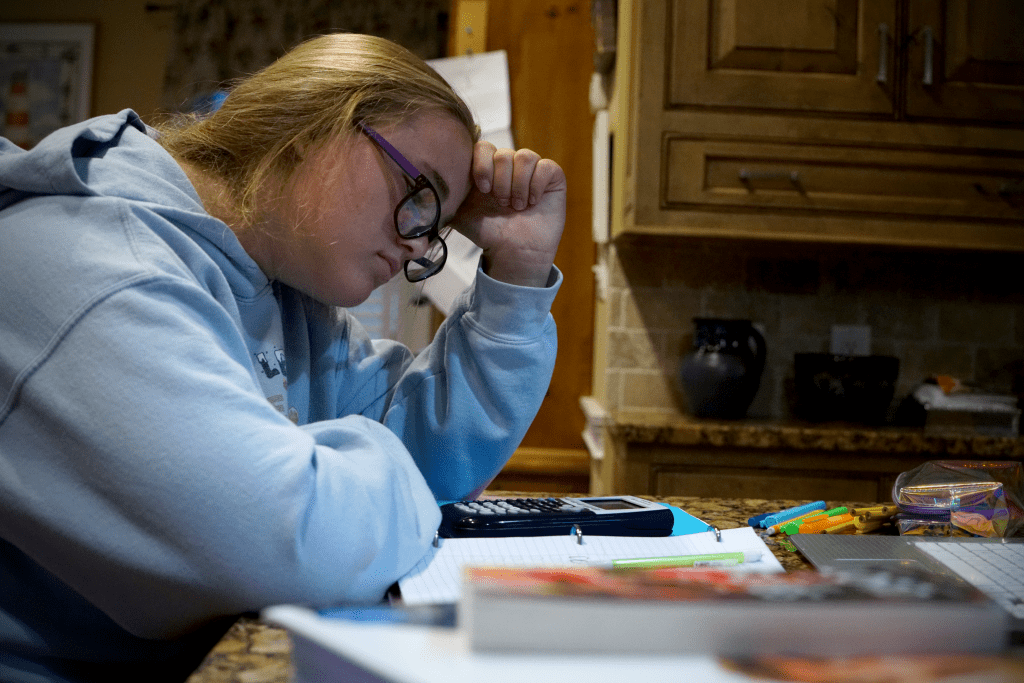
The biggest struggle students face is being completely and utterly alone. Yes teachers have been doing their best to answer their emails and try to explain every project and assignment as well as they can, but the students are alone. They sit in their bedrooms or at their counter tops and are just confused and defeated.
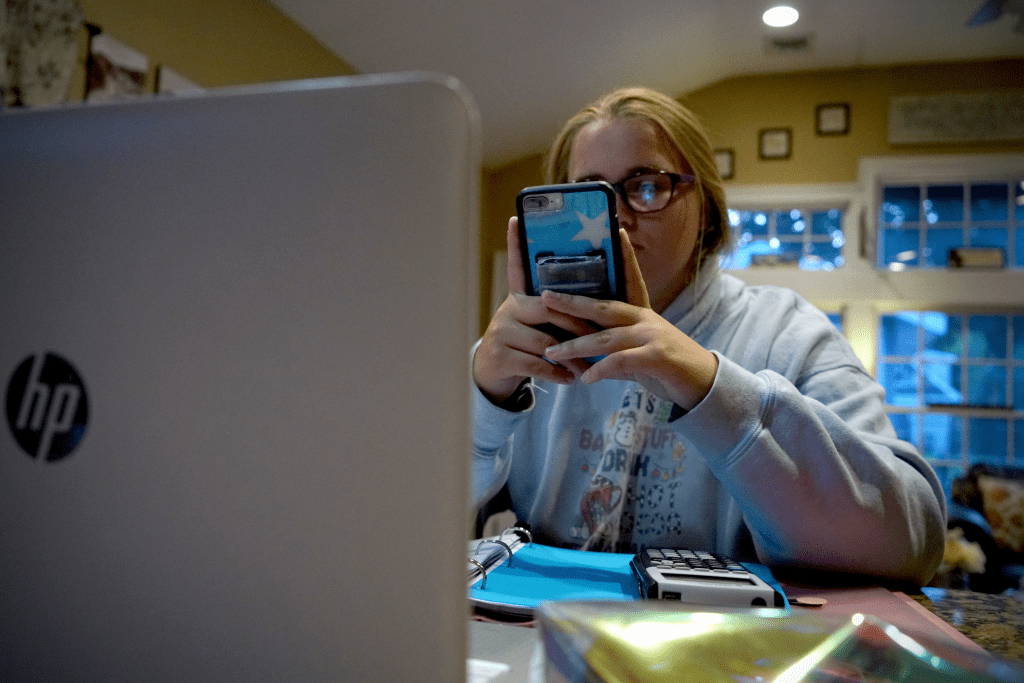
Of course, the biggest distraction is the unlimited use of their phones. At school their phones are either off in their lockers or their book bag and teachers take them away if they see them out, but who’s to say no when no one is around. Both of Kelly’s parents have jobs too. They aren’t home to reprimand her either. She’s on her own and she spaces out often.
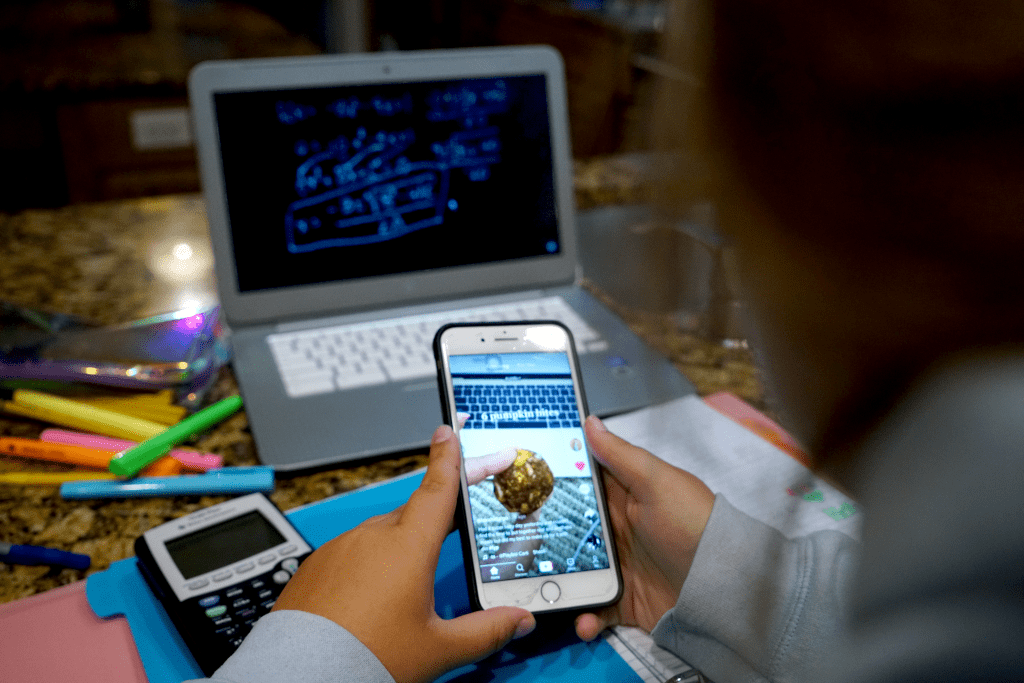
Many times Kelly and other students use their phones to look up answers or try to do productive things. But with the unlimited use of phones comes the unlimited use of social media platforms. Kelly is in the middle of math class, her least favorite subject, and instead of listening she’s checked out and is watching baking videos on Tik Tok.
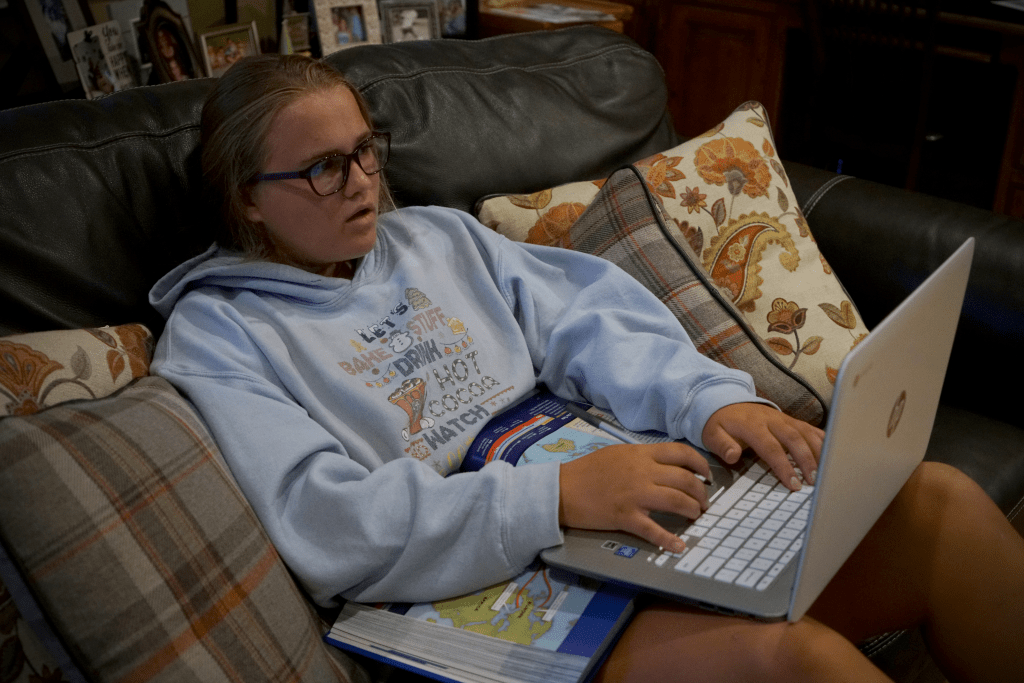
As the day progresses Kelly gets more and more tired of sitting and listening so she migrates to the couch and while sitting on the couch she gets more comfortable and eventually another distraction creeps its way into her education… the TV. Her face says it all. The warm glow of the TV is far more interesting than whatever mindless assignment she was given on her computer.

The other side of the previous photo shows that constant access to any streaming service or channel are far more appealing than SAT Prep. Right now students aren’t thinking about their future or how important their education is. They’re thinking about how their eyes hurt and how they haven’t seen their friends in weeks and they just want to be able to turn their computers off and forget about school.
Students right now are stuck repeating the same day over and over again. They’re not learning as much as they have in the past and frustration and resign are at an all time high.
Project Rationale
Digital Journalism is still new to the news industry. Incorporating photos, video, graphics and special design into stories and not just throwing them in at the end as an afterthought. For my journalistic storytelling project, I knew I was limited. I work all day for half the week and don’t have any time to actually take any photos at work, but I also wanted to do a story that wasn’t just something in my town or only affecting my life. I wanted to show something that is affecting many people right now but in a personal way. In the 4 Principles of Storytelling they take heavily about making things authentic and relevant and that’s what I did with the topic of at home learning being a subject that can honestly affect most people in the US today.
Living at home this year to complete my final year of school has definitely been a challenge, but it is nowhere near as bad as the younger generation of students who are stuck day in and day out on zoom trying to get through elementary, middle, and high school. With this in mind I was going to show my younger sister’s story. I decided to follow her around all day from the moment she woke up and opened her computer to the moment her last assignment was submitted and she could close her computer. In another article on visual storytelling, the photographer Lynn Johnson described new age photojournalism to be the need to “have the courage to look onward as well as inward”. In this project the goal wasn’t just to take a few photos and get a surface look at Kelly’s day. I wanted to see it all and then pull my story from everything I shot.
After taking hundreds of photos of her for hours, I scrolled through all of them and picked the ones that I kept finding a theme through. That theme being, distractions. That was the story I was trying to tell. Even though schools and teachers are trying to keep class interesting and trying to give students all the resources they need to get through the year no teacher or faculty member can combat with at home distractions, like food, phones and the TV.
Like the author of the article on Medium said, “Photo storytelling is different from a picture portfolio or collection… In a photo narrative, the storyteller is presenting a finite number of pictures around a theme or an event to communicate what happened, define a situation or show details about characters. Photo-driven stories evoke a deeper understanding of scenes and details — the color of a person’s car; the scene of a crime; emotions written on a person’s face.”(Shurbaji). Depicting the struggles and distractions of Zoom school was my story.
My photos were up close and personal with Kelly, they showed her face and her natural emotions throughout the day. In Robert Plutchik’s wheel of emotions, shows the 8 basic emotions humans have. In the photos of Kelly I wanted to capture all of the emotions she feels throughout the day that are depicted on the chart, like anger, distraction, sadness, boredom, and annoyance.
Another component of good journalistic storytelling is making sure that throughout my photo taking I never had Kelly pose or try to do anything specific for me. I needed it to be the most authentic representation of her and her day. The National Public Radio’s rules for journalists talk about ethics, and accuracy, but most importantly excellence, “Our journalism is most valuable when we marry important truths with engaging narrative. We take enormous pride in the craftsmanship of our storytelling and in the quality of the words, sounds and images we use to help illuminate the world. When we edit, it is to add impact and clarity to our journalism — never to slant or distort. We don’t allow what is sensational to obscure what is significant” (NPR).
The project isn’t earth shattering, but it does give a personal glimpse of the life students are facing right now due to the pandemic. It depicts authentic and close up photos that truly do tell a story. The PJ’s Kelly wears all day, the constant distractions and the complete frustration and feeling of loss all show just how different life is this school year compared to years past.
 taylorsniffen.com
Taylor, I think that your post is very well done overall. Right now I work as a teaching assistant at a digital learning center (it used to be just an after-school program, but we have had to adapt). All of the kids I watch over are in 6th grade or below and it is heartbreaking to see what they have to deal with when it comes to online learning. Just this morning I had a 4th grader dry because the laptops they provide them are unable to handle Zoom calls and he couldn’t understand what his teacher was saying. I think you capture the frustration and all the other emotions of your sister (and all online learners) well in your photographs.
Some areas of improvement have to do with grammar, wording, and some organization. I think that the first paragraph of this post should have been saved for the second part for two reasons. First of all, it felt out of place at the top under the first image. Second of all, that stark transition into the photo story is a bit sudden. There are a few instances of awkward wording as well – I would suggest that you read your writing out loud before posting, although these errors were minor.
Great job overall – your photo essay is very effective.
LikeLike
Hey Taylor,
This is a great and very familiar story. You did an excellent job of capturing authenticity in a way that feels polished and not posed. The lighting is particularly effective; as the day seemingly wears on, the rooms all stay dim, which further carries your feeling of general boredom, restlessness, and discontentment.
I think that one thing I might have liked here was a bit more knowledge of who Kelly was before quarantine. Expanding upon this with more photos and captions could provide a starker contrast with the current images. For instance, you have a really strong line about how she’s not picking out outfits in the morning anymore. I remember that morning process from middle and high school so vividly. Maybe consider throwing in a shot of her pulling on a sweatshirt in front of a closet of unworn clothes, or putting slippers on as her other shoes she normally wears are discarded.
I also think there’s perhaps room to expand upon the missing social component. I’m not able to gauge Kelly’s exact age but obviously students of all ages are missing their friends and social circles right now. Maybe consider framing with some pictures of homecoming or groups of friends in the background or edge of the shot to draw a contrast with Kelly’s solitary study at home now.
In all, I think you did a great job of capturing the exact feeling of exasperation, frustration, and desire to just give up that’s carrying through so many schools right now. Good job!
-Colleen
LikeLike