For our final post of the semester we created comprehensive white papers, detailing the need for deep work with in our field of interest. When originally assigned this project I thought I was going to need to pick between my two top fields of interest in school, journalism and film, but then after thinking for quite some time I realized that both share one huge common theme, storytelling.
So in this whitepaper I look at the decline in good original storytelling due to the decline in deep work and the increase in over stimulation from new technology. I research some of the best storytellers, describe tips and tricks to achieve deep work in this technological age and show just how important storytelling is in all regards.
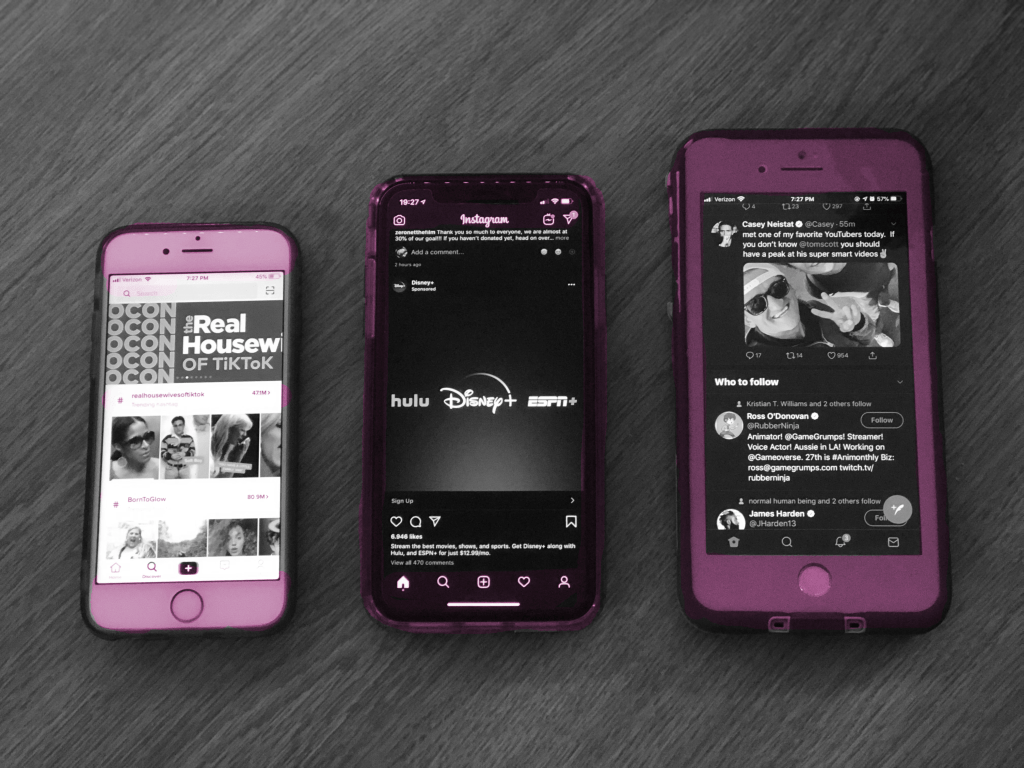
So by the title, it sounds like I’m being super dramatic, and I am, but let me explain. I don’t mean that someone emptied our bank accounts or stole jewelry from inside our house. I mean we’ve been robbed of our time and our ability to think without turning to technology. Over the past few weeks we have discussed the many different ways technology and staying organized and focus can help lead to successful deep work, but at this point in time we have surrendered so much of our time and thought process to different technology, but most specifically our phones.
In Cal Newport’s other book about “Digital Minimalism” he talks about taking back our attention and pulling away from technology, they discuss how companies stole our attention and focus away from us by using our smartphones. “To build a new sector of the economy on the back of this device required somehow convincing people to start looking at their phones … a lot. It was the directive that led companies like Facebook to innovate the field of attention engineering, figuring out how to exploit psychological vulnerabilities to trick users into spending far more time on these services than they actually intended. The average user now spends fifty minutes per day on Facebook products alone,” (Newport).
Looking at technology through this lense is horrifying, it means that if we continue on the path that we’re on we’re gonna end up all psychopaths who have no social skills and can’t look up from their phones. I myself being aware of the dangers, still know that I use technology and my phone way too much each day. When I’m bored I pull out instagram and scroll for ever, and if I run out of things on Instagram to scroll through I jump over to Facebook and scroll through my news feed there. Then in order to further procrastinate my work I go on Youtube and Buzzfeed to escape and pressures and stress that I don’t want to deal with at the moment. But if I already know the damage that it can cause, why don’t I realize that they keep stealing all my time and just stop?
It’s cause they’re so easy to use. “The big companies want “use” to be a simple binary condition – either you engage with their foundational technology, or you’re a weirdo,” (Newport). And Newports right. How often do you give and though something out when you can’t figure it out, but if it’s a breeze to operate and super accessible then there’s nothing stopping you rom using it all the time.
Now as I sit here and continue to type about the horrors of technology just like I have for the past 6 other blog posts, everyone in their right mind knows that you can’t just give it up and run away from all phones, app, social media and technology, it’s not possible in today’s society, but Newport does reveal a way to think about in terms of deep work.
“The problem with this binary response to this issue is that these two choices are much too crude to be useful. The notion that you would quit the Internet is, of course, an overstuffed straw man, infeasible for most… and this reality provides justification for remaining with the only offered alternative: accepting our current distracted state as inevitable,” (Newport 183). As of this moment the first option is how most analysts and deep thinkers believe people should live their lives, void of technology. And the second option is how most people who have to make a living in these time period feel, because at this rate it’s working for them and they all think the world is screwed already, but as I mentioned earlier Newport does believe there is a third option.
“This rule attempts to break us out of this rut by proposing a third option: accepting that these tools are not inherently evil, and that some of them might be quite vital to your success and happiness, but at the same time also accepting that the threshold for allowing a site regular access to your time and attention should be much more stringent,” (Newport 184).
So after all these weeks of blog writing and all these articles screaming the voice of doom about the overuse of technology and that unless you stop your ability to ever accomplish anything deep and meaningful is over, were nothing. In the end, quitting won’t help, but neither will doing nothing. Overall the answer to most people’s issues is moderation, balance and being conscious of your choices. We are able to stop ourselves from being robbed of our time and attention every time we use our phones we just have to be mindful.
Reflection and Review, that’s the theme of the week as we look back and see what we’ve been able to learn so far from this course and from our exhaustive deep work that we chronicle on these blog posts. So that’s the big question, have I actually learned anything? The answer is yes, to my surprise I have actually learned something.
It was subtle and it wasn’t extraordinary amounts of information, but I have learned quite a lot. I’ve learned about the art of the blog and how to present myself and my theme in a professional way. I have learned the importance of project management and scheduling in order to achieve deep work, even if I don’t agree with using all the different project management apps that are in society. But most importantly I have learned/ been made more aware of the fact that I pay no attention of my own health and get overwhelmed and poorly multitask way too often. If you send me a text or email asking me for something, I answer them all at the time of the day or week and never make people wait.
As I continued to look into the important information I have learned over the semester, and keep reading the course materials assigned this week, I couldn’t help but think if there was a way social media or technological distractions were helping or hindering how much we learn in school courses. In the article “The Art of Staying Focused in a Distracting World”, the tech executive Linda Stone talks about as a child we develop our own strategies for learning and paying attention and that even with growing dependence on social media we still have that base practice to go off of. “Let’s talk about reading or building things. When you did those things, nobody was giving you an assignment, nobody was telling you what to do there wasn’t any stress around it. You did these things for your own pleasure and joy. As you played, you developed a capacity for attention and for a type of curiosity and experiment that can happen when you play” (Fallows 2,3). When she talks about learning through pleasure and happiness, it struck a chord, that that’s what hasn’t been connecting with me about deep work. I’ve been going through this class with the mentality that as long as I do the work necessary, I can get the grade, but if I were to just go back to my roots and have fun with the blog, keep pushing the limits of the art work I make for the top of them and spend time daily on it to make it more my own, then I’d probably learn more.
In a new section of Deep Work about “embracing boredom”, Newport brings up a similar point. “A number of these people are highly successful (professionally), but it wasn’t some fancy school that pushed their intellect higher; it became clear it was instead their daily study that started as early as the fifth grade,” (Newport 156). You learn more and retain more the more and more you do it. The more I focus on just this blog and work deeply the easier it will be and the easier it will be to stop getting distracted by other unimportant outside diversions.
So if the answer to learning more and retaining more for long periods of time, is just to take a step back and enjoy the lessons and practice them over and over again, then why does social media and the use of technology constantly get brought up as a hindrance to education?
In the other article we were given this week, “Social media is keeping us stuck in the moment”, the author shows the downside of having a constantly updated reverse chronological news feed. “A culture that is stuck in the present is one that can’t solve big problems. If you want to plan for the future, if you want to handle big social and political challenges, you have to decouple yourself from day-to-day crises, to look back at history, to learn from it, to see trendlines,” (Thompson 4). Just like what we’re doing this week in class which is taking a step back and looking at the past to see how far we’ve come and if I couldn’t separate myself from the present moment then I would have continued on thinking of the class in a negative manner and not seen the value that could come from it.
But after completing the different readings and compiling all I’ve learned so far, I wanted to know more about how social media affects your processing of knowledge because it couldn’t just be that it keeps you stuck in the present moment, and I was right. It doesn’t.
In an article about the “weird effects of social media” it talks about the fact that the overuse of social media creates more grey matter in our minds. And grey matter is the contents in our brains that helps us remember a bunch of things like faces and names, but it doesn’t help us make connections between them, that’s white matter. “In this study, grey matter in the right superior temporal sulcus, the left middle temporal gyrus, and the entorhinal cortex, which are the parts of the brain responsible for social perception (recognizing faces) and memory, respectively, were much higher if a person had a larger social network. Basically, if you have more Facebook friends, you are probably better at remembering things,” (Beres).
So basically constantly using social media leads to our minds being able to remember loads of useless things that none of us actually need in life, but if we were to lessen our use of social media then we could think deeper and make intelligent connections between large concepts. We could also leave the present moment and look back on history in order to see what we’ve learned but also what others before us have learned through their past mistakes.
In the end, when I was told to reflect on this class so far, I groaned and I had assumed it was nothing, but after stopping and thinking, there have been many things I have gained from this course and one of those things being, to stop and enjoy the work you’re doing because you’ll get so much more out of it.
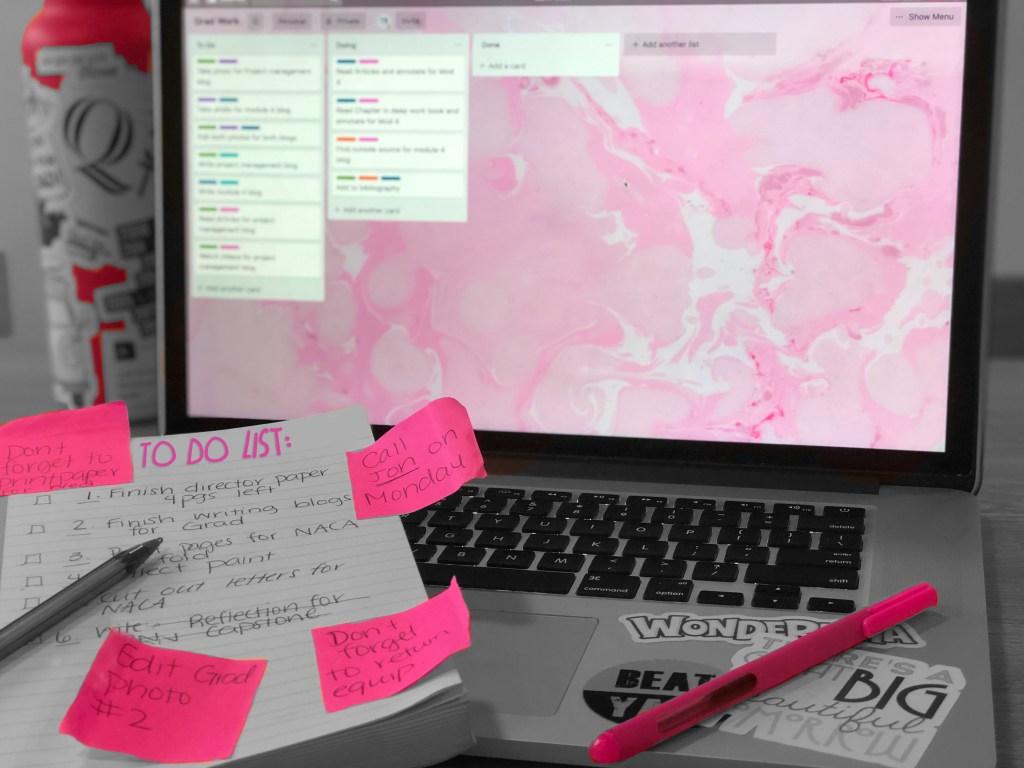
So as I stated in the blog before this one, this week in class we talked about project management and as part of the assignment we each had to set up a work flow page and make a bunch of actionable tasks in order to complete the large project that we chose to break up. I made a Trello dashboard to keep the tasks for my Grad blog in order, but on top of that dashboard I also have a Trello page for my senior capstone, a Wrike account for my branding job at Quinnipiac University, a slack account for my journalism capstone class, and a click-up account for my internship this past summer. Plus calendar reminders from google calendar and outlook calendar when it comes to Student Programming Board events and class assignments. So basically to say the least I have a lot of scheduled things and constant reminders inundating my phone at all hours.
This is why overall, I do not like project management apps, or at least I don’t like how many of them there are. After the week experiment I found that making small tasks to complete in order to complete a much larger did nothing at all to help me complete anything faster or in a more efficient way. I can understand using a project management application when it comes to a larger company because it lets other people see your progress, but breaking up my own personal assignments just for myself helped me with absolutely nothing. In an article written by Fast Company they describe that unfortunately there is no way to make one application do everything you want but there is a way to centralize all the applications. “A ‘container’ concept enables employees to access all of their work applications from one single place,” he says. “The container additionally supports roles based on restricting access to applications and the employee’s function. All enterprise apps including desktop web, native mobile, and hybrid apps should be made available to employees through this container” (Vozza).
During this project, we were also asked to watch videos that explain the importance of project management and my biggest issue with each video is that they had great insight into how to be an exemplary worker, but it didn’t make me think that project management was a necessity for the individual person. In the 5 steps to planning project management, I found that it’s easier to create a timeline and breakdown the job into tangible steps in a very visually and written out with different colors and then to post it up on the wall so you can constantly see it, but it doesn’t constantly pop up and induce stress and anxiety. I also understand that for many other people it might not be the best practice, but it works for me.
But that’s just the point, each project management app is a rigid design, because it is made to be simple for everyone to use, but that doesn’t mean it works fantastically for all types of humans.
Another portion of a different video was the 7 Work Habits You Need to Succeed, and two of the habits were don’t gossip and build in a buffer to allow time. First of all gossip, it’s funny because in the workplace, gossip skyrocketed after these project management applications were introduced because they have individual chat rooms and now all anyone does is talk poorly about other people in the office. And on the other hand, allowing buffer time, makes no sense if you’re wasting time making sure your updating all your checklists and assignment dashboards.
The final video we watched was about working smarter not harder, but this is my biggest problem. For most people since project management apps haven’t been in their lives the whole time they have been working it becomes more work to remember to update all the time. I am someone who thinks if a large hand written calendar or a To Do List works then you should be left to make it and because of that you should not be regarded as being less efficient.
So during all my frustration I wanted go back to the epicenter and see what project management really was. After looking on Wikipedia as to what the actual description is, it said “information usually described in project documentation, created at the beginning of the development process. The primary constraints are scope, time, quality and budget. The secondary—and more ambitious—challenge is to optimize the allocation of necessary inputs and apply them to meet pre-defined objectives.” Now thanks to all the phone, computer and tablet apps this definition is nowhere near close to what it started as. People think making trivial little tasks and then marking them as done is helpful, and creating cute backgrounds with color coded labels is going to get a job done faster and better then, if everyone just made a big calendar and made sure everything gets done by the dates previously determined. It’s ridiculous.
So yes, I understand that I need to learn these new apps in order to work in any company because these are what most places use, but no it does not mean I have to love them and use them to organize my own life. I firmly believe that for the individual person getting constant updates about their unfinished business is just stressful and doesn’t actually push them to do anything and in turn wastes their time.
So we have hit the halfway point in the semester and everyone is drowning in work. And while you might think that must mean deep work and the productivity of long term projects is at an all-time high, in fact, and especially for me, it is at an all-time low. I have so many projects and papers and they all are due at the same time, and instead of properly planning and trying to get a head I just feel defeated and so I slack off and just use my phone.
In the “Sociology of the Smartphone” the author Adam Greenfield sums the use of the smartphone perfectly. “They are the last thing we look at before sleep each night, and the first thing we reach for upon waking,” (Greenfield). This phrase is honestly the truest thing I have read so far. I receive alerts and updates from my phone every night reminding me things that I should have completed with in the day and in the morning I get reminders of things that I must complete for the day. But quite honestly getting these updates and checking my phone at night and in the morning just induces constant stress.
But to my dismay, this week in class we talked about project management, which in another blog I talk deeply about how that went. Personally, I think using these apps and having a constant reminder in your pocket about all the things you’re not doing is pointless. “We find that a great many of things city dwellers once relied upon to manage everyday life as recently as ten years ago have by now been subsumed by a single object” (Greenfield). So if this is the case and people are no longer walking around with a bunch of things in their pockets and purses because the phone is now able to do all of it, is that a good thing or a bad thing? Do these apps actually help us stay organized and get things done or do they just distract and fill us with more anxiety?
On my phone and my laptop, I don’t have any games because I don’t enjoying playing them and I think they are a waste of time so the only updates I get on my phone are texts, calls, emails and reminders from different project management apps I have for different jobs and classes. So even though I don’t waste my time with games I certainly feel like I’m wasting it by constantly checking these apps and watching videos all day, which I have described the addiction to things like YouTube and Buzzfeed in a different blog.
So if society is depending too heavily on their apps and using their phone then why don’t they just stop? Well the answer is because it’s really hard to change your behavior that drastically. So what have researchers and technology designers created to help with that … another app. You can download productivity apps that allow you to monitor how much time you use your phone and reach goals on how little you use your phone that day. For example in an article I found online titled, “Spending too much time on your phone? Behavioral science has an app for that” it talks about certain apps you should download to help beat the addiction to your phone. “Productivity apps like deliberate incorporate these rewards as well, by providing users with points for prizes – such as shopping discounts and yoga experiences – when they meet their screen time goals. Since static rewards become demotivating over time, choose an application that provides uncertain and surprising rewards,” (Whillans). I don’t know enough about other people’s opinions but to me this just seems extremely counterproductive.
Another huge reason I think all the management phone apps are a hindrance is because to do deep work, as Cal Newport would say, is to be completely undistracted. “Bill Gates … was famous for taking Think Weeks during which he would leave behind his normal behind his normal work and family obligations to retreat to a cabin with a stack of papers and books. His goal was to think deeply, without distraction, about the big issues relevant to his company” (Newport). If Bill Gates had been distracted by his own software then he wouldn’t have figured out how to create it.
Over all I think if we want to be happier and more productive then we need to lesson not exactly the use of the whole phone, but the use of all the apps that control all these different aspects of your life. Like project management, sleep, calorie intake, and even when to go to bathroom. It’s insane and it’s addictive. Instead of using apps to manage your life, “Expose yourself to nature. Consider using at least part of your break to get away from technology and spend a few minutes in a natural setting” (Gazzaley, Rosen).
So these past two weeks, we have been discussing the addiction and pitfalls of social media. The biggest issue that was discussed was that Generation Y has become the most addicted to their phones due to the different social media apps that we have. In Jean M. Twenge’s article in the Atlantic she creates a whole new name for our generation just based on our overwhelming use of technology. “The more I talked with young people like Athena, the clearer it became that theirs is a generation shaped by the smartphone and by the concomitant rise of social media. I call them iGen. Born between 1995 and 2012, members of this generation are growing up with smartphones, have an Instagram account before they start high school, and do not remember a time before the internet” (Twenge 2).
Having researched about my generations addiction and seen the issues first hand myself, our class decided we were each going to give up something that we felt we were addicted to for a week and see how much giving up that social media platform or that specific streaming service changed our day to day lives.
I chose to give up Youtube for the week. I have a very busy schedule on weekdays. Each day I have classes, work and club meetings and it doesn’t leave me with a lot of time to do homework so I choose to save most of it for Sundays. The issue is though, because I stack up so many projects and assignments to complete on Sundays I get stressed out and push all the work off by watching hours of Youtube videos. This is very similar to the way Newport explains the need for structure in your day to day life. “When measured empirically, people were happier at work and less happy relaxing than they suspected. And as the EMS studies confirmed, the more such flow experiences that occur in a given week, the higher the subject’s life satisfaction. Human beings, it seems, are at their best when immersed deeply in something challenging,” (Newport 84).
Similarly to what is stated above, I feel more productive and ready to problem solve and think about things that need to get done when I have things scheduled throughout the day. It also helps me to stay away from my phone and not think about wasting time on social media, Youtube or Netflix. But would I become more productive on days I didn’t have anything scheduled if I gave it all up?
After trying this for a week, the answer is an unfortunate no.
By giving up Youtube, I was able to stay off and not watch any videos for a week, but instead of becoming more productive and completing more projects and sitting and contemplating more deep work, I just substituted Youtube for another mind numbing activity. This time I went to Buzzfeed and just went down the line and completed their pop culture quizzes.
I gained no extra time and didn’t up my project completion rate at all. But I did start thinking about another aspect in our reading that I didn’t really see relating to our overall topic this week and then it hit me.
In the article “The Web We Have to Save”, a blogger, Hossein Derakhshan thinks the way we use social media to promote ourselves and everything we make is insane. He wished the internet could go back to the days were you could just write and make stuff and just leave it there to be consumed, but instead everyone is more concerned with the most popular and famous people on the internet. So in the end if you want your stuff to be viewed you have to promote it until it becomes the most popular and famous out there.
“In many apps the votes we cast – the likes, the plusses, the stars, the hearts – are actually more related to cute avatars and celebrity status than to the substance of what’s posted. A most brilliant paragraph by some ordinary looking person can be left outside the Stream, while the silly ramblings of a celebrity gain instant Internet presence,” (Derakhshan 8).
I myself am also a culprit of this. When I waste my hours of watching Youtube videos, I’m not watching things that will help me gain knowledge in any way, I’m watching celebrities do stupid stuff. I’m watching entertainment segments on talk shows, or just hours on end of old Saturday Night Live sketches.
So as I sit down this Sunday to write this blog in the late afternoon (after watching endless Youtube videos for a few hours, because my week with out it was up a few days ago). I realized I have gained no time from this experiment but I have gained the knowledge that I don’t need social media, but I want it social media.
I use it everyday as a way to escape. In another article that rebuttals the idea of social media making our generation unhappy, the author shows data that supports the use of social media as a means of escape. “Take a more granular look at the full range of usage, and it looks like the biggest risk of unhappiness is among those poor twelfth graders who don’t use social media at all,”(Samuel).
If you take away the use of social media completely, then we’re left with just the mundane day to day work we have. And after a long day of completing projects, problem solving and running around to two different jobs, 4 clubs and 6 classes, watching a male celebrity put high heels on and make a fool of themselves makes the day melt away just for a few simple seconds.
These past few weeks we have been reading about social media and how over the past two decades or so these different platforms have taken over and changed the way we as a society do and view things. In a large overarching lesson, social media has changed the way we view people, relationships, social events, art and even natural disasters. But the biggest thing I think social media has changed and made extremely different is how we view and show the death of a loved one.
This past week my grandmother passed away and so I began to think, how should I tell the people around me she’s gone or should I even tell them at all? Many people that I am surrounded by at school and most of my followers on social media never knew who she was, so why should they get to know she’s gone or why would they even care? Yet so many people we follow feel the need to post extremely long messages with multiple photos talking about the family member or friend that recently passed away. Then as you scroll through your timeline you look at all the comments of people just sending hearts and “praying for you”, and the always so popular “sorry for your loss”, but I kept thinking is that really all that meaningful and do the people who leave those comments actually mean them?
So I did some research and found a bunch of studies that talk about dealing with loss and social media. One article that stuck out the most to me was “The Psychological Effects of Grieving on Social Media”. In this article they discuss a lot of the positives it can do and how it helps make people feel closer together during a time of deep sadness, but in the second half of the article it displayed all the negatives of posting online and I couldn’t agree more with many of their points. “Paradoxically, if social media can bring people together after a death, it can also create heightened feelings of isolation, alienation, and anger in some individuals. “Some of the people I interviewed were angered by people who acted closer to the deceased than they originally were” (Surugue). An example of this is when young Disney actor Cameron Boyce died earlier this summer and everyone was posting and mourning his loss as if they actually knew him. When in reality you knew the characters he played on TV, not him.
But what I began to realize the more and more I thought about it, was that the feeling is the same with the productivity of social media. Everything online and on these social platforms is instantaneous. When you ask questions you get an answer in seconds. “If you work in an environment where you can get an answer to a question or a specific piece of information immediately when the need arises, this makes your life easier – at least, in the moment” (Newport 58). This is the same when you post about a tragedy or a death, you get an instantaneous response from people reassuring you that you’ll be okay and they’re all validating your feelings of sadness and sorrow. “What you do is you make it so when someone pulls a lever, sometimes they get a reward, an exciting reward” (Cooper 2). The reward here is validation and reassurance.
Once I made this discovery, I continued thinking and realized that was how it all related to deep work. Due to this instant work environment and the constant need to be connected and have everything given to you within seconds, deep work becomes virtually impossible. Thanks to the brain hijacking of social media, we all want instant gratification. So sitting down, getting no help from outside sources, and having to do this over and over again, over a long period of time and getting nothing back in return, is completely against everything social media has programmed us to be used to. “Technology is contributing toward so-called “continuous partial attention”, severely limiting people’s ability to focus, and possibly lowering IQ. One recent study showed that the mere presence of smartphones damages cognitive capacity – even when the device is turned off. “Everyone is distracted,” Rosenstein says. “All of the time” (Lewis 2).
Clearly, most people with any sense can see that social media and the constant sharing of all of our information and constant use of our different devices can’t be good, but we don’t stop. And I feel that’s because most of us can’t. Technology and social media is our entire lives, we can’t just completely write it off and become a recluse. So the real question is, how do we find the balance? I’m going to keep looking into that on this blog as continue into this semester. But for starters, I think we can all stop posting each time someone in our lives passes away.
So I was told in class to sit down, focus and read a whole bunch of articles and a section of this very daunting book. So I sat down (great I accomplished one step in the process) and then the next step, focusing. Within the first 10 minutes I failed, which made reading and comprehending what I was reading 100 times harder. We as a society have so many other distractions and tasks that we’re focused on at the same time, that we only scratch the surface on everything and we can’t actually dive in and conduct deep work. “Thinking I was doing her a favour I made the video full-screen. But this sent my niece into a panic. “Little TV!” she insisted. “Not big TV!” She needed the smaller screen format so as to monitor the lineup of videos still to come. Focusing, even for a minute, on a single video was no good. She needed the panoply, the stream, the comfort of attending entertainments” (Frick 3). Funny enough though, after I read that, my first thought wasn’t that it was crazy to think she needed to always see all the other videos, it was that as a little kid she rather be watching short youtube videos on kinder toys rather then TV shows and movies about princesses or anything she else liked. From there my thought process spiraled off and I began thinking about how the princess Rapunzel would have been the most focused person. Think about it. She was locked up in a tower for the first 18 years of her life. She had little to no distractions from the outside world, no technology and didn’t have the same opportunities as everyone else to explore a bunch of different topics. When reading Cal Newport’s book “Deep Work” one of the most effective ways people trained themselves to create deep work was to lock themselves away. “His method was drastic but effective. “I locked myself in a room with no computer: just textbooks, notecards, and a highlighter”… Benn gave himself no other option: He had to learn this material, and he made sure there was nothing in that room to distract him” (Newport 11). Rapunzel didn’t have to force herself she was just stuck. She read and reread her books over and over, she sat for hours just thinking and creating art. She had no one else to stray her from deep work. In another article I was researching “Studying with Distractions” an additional huge reason people become distracted and can’t complete any tasks is due to background noise. “At the outset, you should know that background language is usually shown to be distracting and hurt any processing of language” (Wooldridge). Again no one other then her mother was ever up there so no background noises were there to ever distract her. The more and more I thought about this, the more depressing it was to think that a fictional character could do better and deeper work than me, and I knew I was going to need to step my focusing techniques up.





 taylorsniffen.com